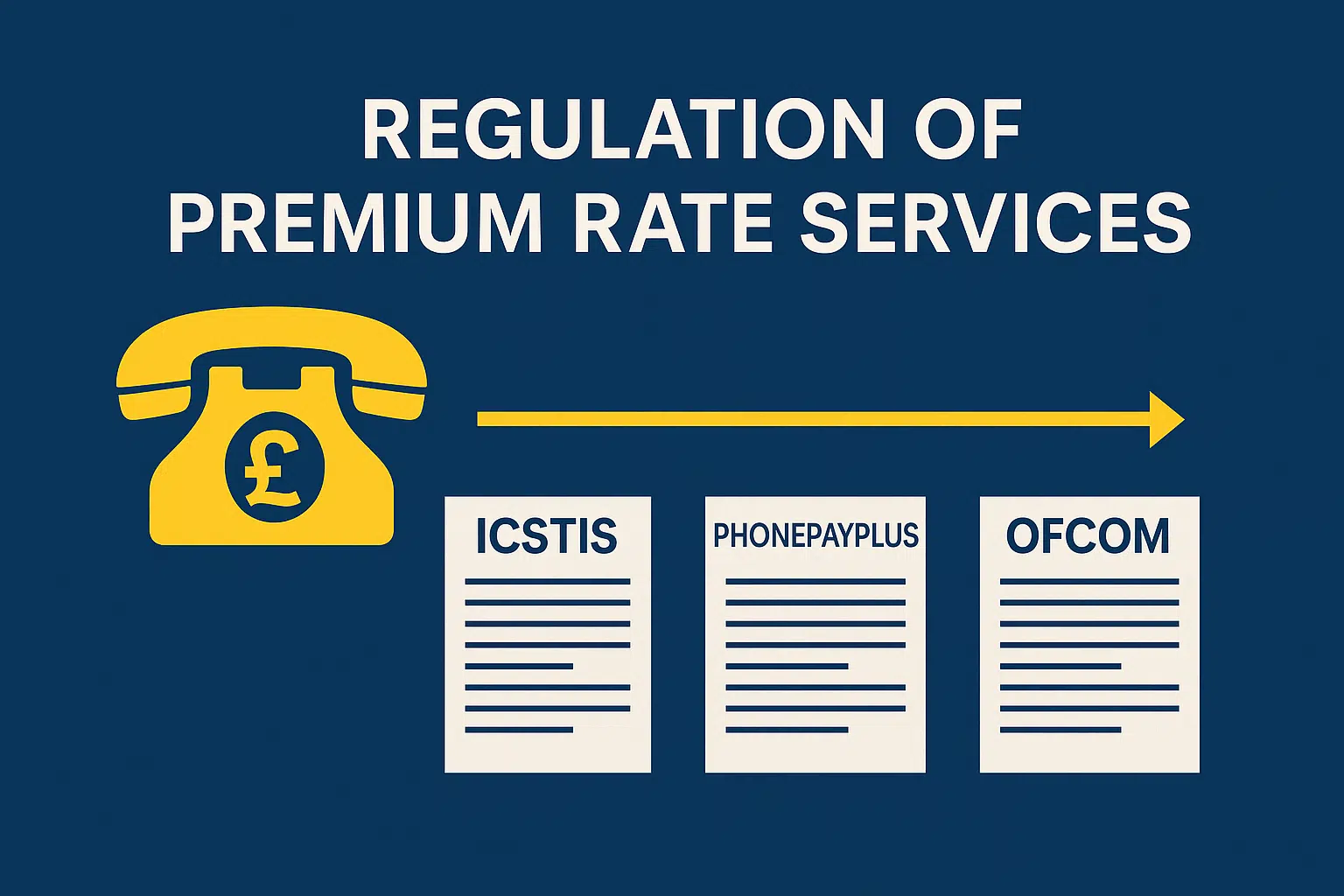
The UK’s rules for premium rate and phone-paid services: from ICSTIS to Ofcom
Premium-rate and phone-paid services have been a part of British nightlife for decades. Behind the cheeky chat and late-night ads lies a very real regulatory framework that has evolved significantly over time. If you run a service or want to understand who sets the rules and why prices are displayed in a certain way, this guide walks you through the key milestones.
Quick timeline
- 1986: ICSTIS begins supervising premium rate services with a Code of Practice.
- 2003: Communications Act gives Ofcom powers and a framework to regulate PRS.
- 2007: TV phone-in scandals, ICSTIS rebrands as PhonepayPlus, Ofcom tightens oversight.
- 2009: 0871, 0872 and 0873 services come under the premium rate regime.
- 2015: “UK Calling” introduces access charge plus service charge pricing and makes 080 numbers free from mobiles.
- 2016: PhonepayPlus becomes the Phone-paid Services Authority.
- 2022: PSA Code 15 approved and goes live with a stronger standards-based approach.
- 2025: Ofcom becomes the day-to-day regulator under the 2024 PRS Order.
What counts as a premium rate or phone-paid service
In UK regulation, “phone-paid” and “premium rate” refer to services where the charge appears on your phone bill or is deducted from your prepay balance. That includes calls to 09 and 118 numbers, as well as many services on 087 ranges that exceed certain prices, and mobile shortcodes used for activities such as charity donations, competitions, voting, and chat. These services have long been subject to a dedicated set of rules and a code of practice approved by the communications regulator.
The early years: ICSTIS writes the first code
Regulation began in 1986 under ICSTIS, the Independent Committee for the Supervision of Standards of Telephone Information Services. ICSTIS emerged as the industry and the public needed clearer standards for the growing premium rate market of the 1980s and 1990s. It policed advertising, pricing transparency and service conduct through a Code of Practice.
Ofcom’s legal powers arrived in 2003
The Communications Act 2003 gave Ofcom the power to regulate premium rate services, approve an industry code, and set binding conditions for the sector. In plain English, this created the legal scaffolding for Ofcom to oversee the market, while an approved code set day-to-day rules for providers.
2007: scandals, a rebrand and tighter oversight
A string of TV phone-in scandals in 2007 led to heavier scrutiny. ICSTIS rebranded as PhonepayPlus, and Ofcom tightened its oversight of the watchdog’s governance and code approvals after high-profile investigations and fines across multiple broadcasters. This period cemented clearer accountability between Ofcom and the premium-rate regulator.
2009: bringing 0871, 0872 and 0873 into scope
To protect callers using non-geographic numbers, Ofcom extended the premium rate framework to cover services on 0871, 0872 and 0873, aligning those lines more closely with the rules already applied to 09 and 118 services. This change was made following consultation and took effect in 2009.
2015: the “UK Calling” pricing overhaul
From 1 July 2015, Ofcom introduced the “UK Calling” reforms, allowing callers to see costs in a simple, two-part format. Prices for 084, 087, 09, and 118 numbers must be displayed as an access charge from your phone company, plus a service charge set by the service provider. Freephone 080 numbers also became free from mobiles. This is why ads and websites now display “Calls cost Xp per minute plus your phone company’s access charge.”
2016: PhonepayPlus becomes the Phone-paid Services Authority
In 2016, PhonepayPlus rebranded as the Phone-paid Services Authority, defining itself as the UK regulator for content, goods and services charged to a phone bill. The name change sat alongside updated code work and a clearer public mission.
2018 to 2022: tightening definitions and raising standards
Ofcom has periodically updated the Premium Rate Services Condition to capture harms that were slipping through the net. One example was bringing Information, Connection, and Signposting Services into the “controlled” premium rate definition, regardless of the number range. In 2022, the PSA’s fifteenth Code of Practice came into effect, adopting a more proactive, standards-based approach with enhanced supervision and due diligence requirements throughout the chain.
2024 to 2025: Ofcom takes over as the day-to-day regulator
In late 2024, Ofcom set out that it would take on direct regulation of phone-paid services. The Regulation of Premium Rate Services Order 2024 came into force on 1 February 2025. From that date, Ofcom withdrew approval for the PSA’s Code 15 and replaced it with Ofcom’s own rules under the Order. The PSA was wound down and made dormant in January 2025, with remaining funds transferred to Ofcom.
What “controlled PRS” means today
Under the 2024 Order and Ofcom’s PRS Condition, a “controlled PRS” is a premium rate service that meets certain price thresholds or falls into specific categories, regardless of its price. That includes 087, 09, and 118 numbers above the defined service-charge levels, many mobile shortcodes, sexual entertainment services, chatlines, and all information or connection services. Providers of controlled PRS must follow Ofcom’s rules and can face enforcement if they do not.
If you operate a service: registration and compliance
If you are launching or running a premium rate service, you must check whether your activity is regulated, register with Ofcom and comply with the PRS Order. New services must be registered at least five working days before going live, and the register must be kept up to date. You will also need clear pricing in all ads, proper age-gating where appropriate, and robust due diligence and risk controls over partners.
If you are a consumer: how to read prices and who handles complaints
When you see a service number, look for the service charge right next to the number, and remember your phone company adds its own access charge. If the price is unclear, that is a red flag. Today, Ofcom is the regulator responsible for enforcing the rules and taking action against non-compliant providers. It publishes guidance on charges and how to complain.
Why does all this matter
Premium rate and phone-paid services are a small slice of the communications market, but they touch a lot of everyday behaviour, from TV voting and charity texts to late-night entertainment. The journey from ICSTIS to the PSA and now to Ofcom reflects a steady push toward clearer prices, fairer advertising and stronger accountability. For callers, that means fewer surprises on the bill. For providers, it means clear rules, clearer enforcement and a level playing field.
A premium rate service (PRS) is any service where the cost is charged to your phone bill or deducted from your prepaid balance. This includes 09 numbers, 118 directory enquiries, some 087 numbers, and mobile shortcodes used for chat, voting, competitions, and donations.
Today, premium rate and phone-paid services are regulated by Ofcom. Ofcom took over direct regulation in February 2025. Before that, the Phone-paid Services Authority (PSA) was responsible, following earlier regulators ICSTIS and PhonepayPlus.
The PSA was an industry regulator that operated under Ofcom’s approval. In 2025, Ofcom assumed direct responsibility, meaning there is now a single regulator for all communications and premium rate services in the UK.
Since 2015, Ofcom has required providers to show charges as two parts: an access charge (set by your phone company) and a service charge (set by the service provider). This makes costs clearer and helps consumers compare prices.
Controlled PRS are services that fall within Ofcom’s PRS Condition. This includes services over certain price thresholds, sexual entertainment services, chatlines, information and connection services, and all directory enquiry numbers.
If you have a complaint, start with your phone company, as they handle billing. If the issue relates to the service itself, you can contact Ofcom, which now enforces the rules directly and can investigate providers who break them.
Yes. Since 2015, all calls to 080 numbers are free to call from both landlines and mobiles in the UK.